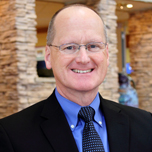
Curt Stutzman will retire from Messiah Lifeways September 30.
Curt Stutzman will be retiring from Messiah Lifeways on September 30, after eight years with the organization.
Stutzman oversaw the Project Envision expansion that created new living spaces across the Messiah Village campus, and the expansion of Mount Joy Country Homes. During his tenure, the Rising Leaders Academy developed leaders at all levels and encouraged executive leaders to acquire graduate degrees.
Stutzman plans to take some time off to travel, spend time with family, and spend purposeful time discerning the structure of the next stage of life. He says, “I am looking forward to exploring a wide range of exciting alternatives for a fruitful and purposeful next stage of life.”
John Thorhauer started as the new President and CEO at Glencroft Center for Modern Aging this month.
Thorhauer previously served as President and CEO of UMRC and Porter Hills in Michigan, where he served for 14 years starting as Vice President of Administration.
Prior to that, he was Director of the Armed Forces Retirement Home in Gulfport, Mississippi.
The financial and strategic pressures from COVID make a highly functioning Board of Directors more important than ever. MHS offers a number of tools and resources to support excellence in Board Governance.
Are you making the most of your MHS membership? The following are available to all MHS Members at no added cost. Email info@mhsonline.org or call 574.534.9689 for more information.
MHS Board Self-Assessment. The Board Self-Assessment blends perspectives from various governance approaches and includes the following dimensions: board practice, fiduciary oversight, strategic engagement, generative/creative work, integration of faith and values in board work, and personal board member engagement. The assessment process typically takes 5-7 weeks. It is recommended that self-assessments be completed every two or three years.
MHS Board Peer Assessment. The MHS Board Peer Assessment tool is a brief survey typically used to measure a board member’s individual position on the board as they are being considered for reappointment.
MHS Original Resources. MHS has created a number of resources to better serve our members and those interested in board development. Please take a look at the resources below. Visit the MHS webpage for more tools and resources at http://www.mhsonline.org/governance
Informal Consultation. Sometimes it is good to have someone to talk to about a particular governance challenge. MHS loves engaging with our members.
Innovating Level Members. MHS’s most robust membership includes: consultation and support for board member recruitment; annual board education by MHS staff; Board monitoring schedule and meeting planning; and strategic planning or other consultation engagement by MHS staff triennially.
Webinars. MHS offers many webinars each year. Sign up to receive webinar notifications at http://www.mhsonline.org/webinar-series. Do you see a webinar that you wish you hadn’t missed? Email or call MHS and we will be happy to email a link to the video to our MHS members.
The following resources are available at additional cost.
MHS Consulting Services. MHS Members receive a discount on consulting services including, but not limited to strategic planning and CEO searches. Mennonite Health Assembly. MHS’ annual gathering of MHS member leadership. The March 2022 Health Assembly will feature a pre-conference extended workshop on Governance Training for the CEO & Board Chair as well as a one-day track on Strategic Positioning. Additional workshops suitable for Board members will be offered.
You cannot lead others to a destination you have never been. The journey of many begins with your own personal journey. In John Maxwell’s wisdom he writes: “A leader is one who knows the way, goes the way, and shows the way.”
Diversity, equity and inclusion is the new hot topic. There are many reasons “why” your organization should consider heading in this direction. How do you lead such an endeavor? It begins with you. Are you ready to start your own personal journey?
This makes me reflect on my own personal journey into “awakening” as some call it, which began after the death of George Floyd. I had completed anti-racism training 15 years earlier but never felt the calling to educate myself further. As with many, George Floyd’s death sparked a new level of humanity in me. I began to delve into every movie, book and documentary I could get my hands on.
For the first time, I wanted to really understand terms like “white privilege” and “systemic racism”, as well as dissect the differences between racism, supremacy, and dominance. Guess what happened when I did this?
A passion stirred within me. I began to see the injustice of systems that were set in place to advantage white men. I began sharing my new found knowledge. Organically people began following me. Sidenote: not everyone embraced my passion and views. Leading is not for the faint of heart. It takes courage, especially when leading in diversity, equity and inclusion.
Are you feeling a calling to DEI within your ministry? Are you feeling a “personal” conviction? Good…it has to be personal. Remember, you cannot lead where you have never been.
The first step you can take toward your personal journey is to prioritize your DEI education:
Read, read, read! I personally recommend White Fragility by Robin Diangelo. The book helps you understand your own resistance as well as the resistance you will receive from others as you move closer to DEI within your organization and other aspects of your life.
Become familiar with black history. The video, Holy Post – Race in America, is a synopsis of black history and the laws that were put into place that led our country to systemic racism.
Learn to empathize with the journey of black men and women. We are a product of our environment. Put yourself in their shoes. The video, Dr. Joy DeGruy Leary: Post Traumatic Slave Disorder , is one source to aid you in this.
Embrace the message of God in regards to diversity, equality and inclusion. “There is neither Jew nor Greek, there is neither slave nor free, there is no male and female, for you are all one in Christ Jesus,” Galatians 3:28. Delve into the scriptures and let God lead you!
Arielle Schultz, Compliance and Risk Manager at Mennonite Village
MHS interviewed Arielle Schultz, Compliance and Risk Manager at Mennonite Village in Albany, Oregon to give our readers a first-hand look at the experiences of a risk manager.
Share how you came to the role of Risk Manager at Mennonite Village.
I worked at the Mennonite Home as a CNA/Team Leader in the rehab unit for roughly 4.5 years as I was going through school. During these years I received my Associate of Arts degree from the local community college then changed my major from nursing to communications and enrolled at a university about 40 minutes away. I spent two years driving back and forth from work to class working extremely modified shifts to make my educational dreams happen. After I graduated with my Bachelor of Arts in communication with a minor in Spanish, I continued working as a CNA for another 2 months when the position as Compliance and Risk Manager became available. At the time, my staffing coordinator, called me and urged me to apply. It was a quick turn around from that conversation and within a few weeks I had two interviews, both while still wearing my scrubs, and was offered the position.
What have been the greatest challenges in your role and work that you’ve had to overcome?
The greatest challenge for my role has been advancing this role from a nursing-based risk management position to a campus wide risk management and compliance one. I do not think the rest of campus knew what to think of this new role stepping into their territory, and unfortunately it was met with some resistance at first. It took time to relay to all the departments that my role was here to be a support and not a replacement to any of their existing staff. I was able to find my way into these groups to where they saw me as an asset and not a hinderance. Once this position truly became a campus wide role, I was able to bridge the gap between the departments since I attended such a variety of meetings and was part of most departmental committees. This change also brought the ability to increase consistency across departments, in minutes, trainings, and processes. These were hurdles at the time, but well worth the time and energy to get there.
Share a positive highlight, achievement or something you are proud to have accomplished in your role.
I am very proud of the educational components of my role that have been streamlined. There are more campus wide trainings on our campus than ever before. We now have a campus wide compliance, risk management, HIPAA, setting realistic expectations, and fair housing trainings that are given to all staff. The formatting is consistent, all staff receive the same information, and all the requirements are streamlined for effectiveness. I feel that we are able to now show accountability for these trainings, and that staff truly learn something throughout the process. I make sure to update each training annually with new examples and statistics, which I feel makes for a strong level of engagement.
The Risk Manager role comes with great responsibility, share how you are able to work within the team at Mennonite Village to ensure there is a culture of safety.
This has been a difficult challenge over the years, but slowly has gotten easier with each year that has gone by. I think that the best way to try and ensure a culture of safety is to be open and transparent about the issues and concerns on your campus, and then offer suggestions and training that can be easily relayed to all staff. I think when staff feel they can see a clear view of the concerns then they are more apt to be engaged in the process of trying to correct them. Finding a way to increase consistency across campus only helps the process. It is great to see staff from across our campus have the same understanding of key risk management processes and that reporting concerns ultimately leads to less work for them and a safer environment for the residents.
Understanding that you work with the Peace Church program, share how their resources and services support you in your role.
It has been great having the resources from the Peace Church available, especially ECRI. Knowing that there are resources available so that you do not always have to start from scratch is a nice comfort. Also, the continued number of pertinent webinars cannot go unnoticed either. It is great to use such a vast variety of resources to educate our campus and stay up to date on current trends in risk management.
Anything else that you would like to share with MHS members about the risk management role at Mennonite Village?
With every role, consistency is key and sometimes that results in some uneasiness when departments have been doing the same thing for years. Getting buy in from multiple departments and developing one plan that works best to satisfy the needs of all departments is a difficult road, but the best one to go down. Being a risk manager is a tough role, but if you are diligent, focus on doing the right thing, and remain approachable, it will only align to make your job easier to navigate and better for the community overall.
What is the role of the Board when it comes to risk management? There are several reasons why a governing Board needs to pay attention to issues that relate to organizational risks;
It is the Board’s responsibility to ensure effecting planning for all of the programs and service lines of the organization, including the awareness of where the organization may have its greatest liability risk and ensuring there is protection or safeguards in place,
Overall protection of the organizations assets and resources requires a solid risk assessment and plan,
And finally, the Board’s ultimate responsibility is to ensure the legal and ethical integrity of the organization which can only be done through a robust and thorough risk management program.
For a full review of the Board’s role in risk management, please see the BoardSource resource that is available to you. One of the benefits of your MHS membership is being able to ask questions about governance related matters to MHS staff. Send questions to Info@mhsonline.or
After more than eight years of service, Alisa Miller will resign as MHS Chief Financial Officer and MHS Consulting Managing Director, to pursue a new opportunity as CEO of Kairos Health Systems, a wholly owned subsidiary of LeadingAge PA.
Alisa joined MHS Consulting in January 2013. In that role, she served MHS members and other clients by providing various consulting services. In September 2014, Alisa took on the Vice President of Finance position with MHS. In November 2017, Alisa was named the MHS Consulting Managing Director, balancing both roles for the last four years.
MHS President/CEO, Karen Lehman says, “I am deeply grateful for Alisa’s dedication and leadership to MHS throughout these years. She’s been a great colleague and will be missed!”
Jarrod Leo, chairman of the Kairos Board of Directors says, “We are thrilled to welcome someone of Alisa’s caliber and experience to Kairos, and look forward to the opportunities that lie ahead under her leadership.”
Miller’s last day at MHS will be August 27, and she will be succeeded by Jeremy Kauffman, who has been with MHS Consulting since 2019. All of us at MHS and MHS Consulting wish Alisa the best as she moves into her new role and responsibilities. She will be missed.
Obie for Seniors is an award-winning interactive gaming system that offers meaningful play for seniors. Seniors engaged in high quality, active play-based experiences will feel better about their physical capabilities and improve their willingness to socialize.
Obie for Seniors is a high touch, high-technology, interactive gaming system that projects onto any surface – tabletops, floors, and walls – encouraging active play through touching, moving, and hand-eye coordination skills. The device uses sensors to identify movements and offers a suite of games to enhance movement, cognition, and social interaction.
Upgrade the quality of care for our residents by making a commitment to offering state-of-the-art technology. Obie for Seniors has received numerous awards for its innovative solution to enhancing quality of life for older adults, including first place in LeadingAge California’s 2021 People Choice Award, first place in the Mediterranean Towers Ventures’s Agetech ‘Startup of the Year’ Competition 2021, and others. Obie for Seniors technology by EyeClick is a new CPS vendor partner. Contact Dianne Piet, your dedicated CPS Client Account Manager, at 603-935-7923, email: pietdianne@carepurchasing.com, to begin improving your residents well being.
Engagement. It’s a buzz word we hear a lot lately. How do we engage our colleagues and keep them engaged? How do we engage our clientele in our services and our donors in our cause? How do we keep ourselves engaged in our ministry’s mission?
We ask these questions because we know engagement matters. Engagement is tied to employee satisfaction and retention. It is correlated to positive health outcomes for those we serve in the health and human service industry. It brings vibrancy to our ministries and success to our fundraising campaigns. It gives us energy and motivation in our own work and helps prevent burnout.
Yet, it can be elusive. Especially lately.
I was able to take a week of vacation recently. Somewhere around day 5, I came to a realization that has the power to drive my own engagement on multiple fronts. The steps by which this realization came to be are simple. They also take intention and time.
Make space to reflect on your own or conversationally.
Consider these pandemic months. What have you lost? What have you gained?
What have you discovered matters to you? What doesn’t?
When it comes to choosing how you will spend your resources of time, talent and money, what single thing is most important to you?
Given that your time and life are precious, and not to be taken for granted, how can you use this thing as a litmus test for what you say yes or no to?
How can this thing motivate you in your work, your relaxation and your relationships? How can you use it to serve God?
How can you hold yourself accountable to living into this sense of purpose?
If you manage people, be curious about what is most important to them and how it can be harnessed and built upon to support your mission. If you fundraise, seek to discover what it is for your donors to bring about deeply meaningful gifts. Ask those you serve and look for big and small ways your organization and your daily work can help them live into their purpose. Seek clarity on what is most important to you. When you experience the engagement that comes from this, you may find yourself motivated to help others find it as well.
Understanding what engages you and others is powerful. Discovering what it is in others is relational. Connecting it to your ministry is missional.






 eConnections